

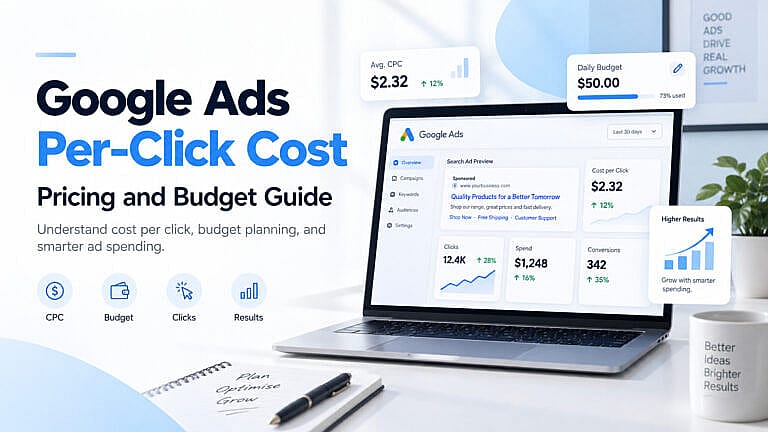
Google Ads does not have one fixed price per click. Your cost depends on the auction, the searches you target, your advertising strategy, and the quality and relevance of the advertising experience. Google evaluates several factors when determining Ad Rank, including bids, ad quality, competition, and search context.
The useful question is not simply “How cheap can a click be?” It is “What can my business afford to pay for a click that has a realistic chance of becoming a customer?”
This guide explains current benchmarks, the calculations behind advertising costs, and how to judge whether your spending makes sense.
What Does Cost Per Click Mean?
Cost per click, or CPC, is the amount paid for an advertising click. Your average CPC is calculated by dividing the total cost of clicks by the number of clicks received. This is different from the maximum bid you may set or the actual price of an individual click. Google explains these distinctions in its CPC documentation.
Average CPC = advertising cost ÷ clicks
For example, spending US$600 for 200 clicks produces an average CPC of US$3.
Throughout this article, benchmarks and worked examples use U.S. dollars. Canadian advertisers should use their account currency consistently rather than treating USD figures as CAD.
What Is the Average Google Ads Cost Per Click in 2026?
WordStream and LocaliQ’s 2026 search-advertising report reports an overall CPC benchmark of US$5.42.
Its dataset covers 13,474 U.S.-based search campaigns running between April 1, 2025, and March 31, 2026. The report discusses Google and Microsoft search advertising, and its reported “averages” are technically medians. These are reference figures—not a guaranteed Google price or a Canadian market average.
| Industry | Reported CPC benchmark, USD |
|---|---|
| Arts and entertainment | $1.63 |
| Restaurants and food | $2.05 |
| Business services | $5.87 |
| Industrial and commercial | $5.87 |
| Dentists and dental services | $8.00 |
| Home and home improvement | $8.33 |
| Attorneys and legal services | $9.87 |
Source: WordStream/LocaliQ, 2026 search-advertising benchmarks.
Use this table as a starting comparison. Your location, keywords, campaign mix, and definition of a valuable customer may differ substantially from the sampled campaigns.
Why Can Two Businesses Pay Different Prices?
Google’s Ad Rank documentation identifies several influences: your bid, ad and landing-page quality, auction competition, thresholds, the context of the search, and the expected impact of assets.
That means changing the bid is only one way to influence performance.
A business advertising a specialist service in a competitive city may face a different auction from a retailer promoting a low-cost product. Comparing their CPCs without considering the different commercial goals would be misleading.
Also distinguish between Quality Score and the auction itself. Google describes Quality Score as a diagnostic tool, not a direct auction input. Use it to investigate expected click-through rate, relevance, and landing-page experience—not as a simple formula that guarantees a particular price.
A Cheaper Click Can Produce a More Expensive Lead
Consider these two hypothetical campaigns. Both spend US$1,000 and count leads using the same definition.
| Measure | Campaign A | Campaign B |
|---|---|---|
| Advertising spend | $1,000 | $1,000 |
| Average CPC | $2 | $5 |
| Clicks | 500 | 200 |
| Click-to-lead conversion rate | 2% | 10% |
| Leads | 10 | 20 |
| Advertising cost per lead | $100 | $50 |
Campaign B pays more for every click but produces twice as many leads at half the cost per lead.
These are illustrative calculations, not HMDIA client results or promised outcomes. They also do not establish profitability: the quality of the leads and the number becoming customers still matter.
The distinction is useful when investigating why a website gets traffic but no leads. More visits are not necessarily the solution.
How to Calculate an Affordable CPC
Work backward from a realistic acquisition target.
For a lead-generation campaign:
Target cost per lead = target advertising cost per customer × lead-to-customer rate
Target average CPC = target cost per lead × click-to-lead rate
Here is a hypothetical example:
| Assumption | Value |
|---|---|
| Target advertising cost per new customer | $300 |
| Percentage of leads becoming customers | 20% |
| Target cost per lead | $60 |
| Percentage of clicks becoming leads | 5% |
| Target average CPC | $3 |
The calculation is $300 × 20% × 5% = $3.
This is a planning model, not an automatic bidding recommendation. Choose an acquisition target that leaves room for delivery costs, overhead, marketing fees, and profit. Update the assumptions when actual results become available.
For an online store, the same principle applies using purchase rate and the advertising cost you can afford per order.
How Much Daily Budget Should You Set?
Your daily budget should support your goals and the amount of useful traffic available. A low budget is not automatically wrong, but it limits how many clicks you can purchase.
For illustration, US$20 spent at US$5 per click buys approximately four clicks. That small sample cannot tell you much about long-term conversion performance.
Google’s spending-limit documentation explains that most campaigns can spend up to twice their average daily budget on a particular day. With an unchanged average daily budget for a full month, the monthly spending limit is generally 30.4 times that budget. Exceptions apply to some campaign arrangements.
For a typical eligible campaign with a US$50 average daily budget, that means up to US$100 on an individual day and a US$1,520 monthly limit under those conditions.
Keep agency fees, landing-page work, and other marketing costs separate from the platform’s advertising budget.
How to Reduce Wasted Spend Without Losing Good Customers
1. Review the Searches Behind Your Clicks
Look for searches that clearly do not match your offer. Negative keywords can exclude unwanted searches, but excessive exclusions can also prevent relevant customers from seeing your ads.
Do not copy a universal exclusion list without reviewing it. A company offering free consultations, for example, should think carefully before broadly excluding the word “free.”
Removing irrelevant clicks may improve efficiency even when your average CPC does not fall.
2. Make the Ad and Destination Agree
Send visitors to a page that explains the service or product advertised. Check that the offer, location, and next step remain consistent after the click.
Google includes landing-page quality in its advertising assessments.
As a practical review, ask whether the destination answers the visitor’s main questions and whether its form, booking process, or checkout works. Our guide to UX, UI, and website conversions provides additional context.
3. Evaluate Customers, Not Just Form Submissions
Compare leads against your sales records. Separate genuine enquiries from spam, unsuitable requests, and duplicate submissions.
A campaign generating fewer qualified leads may be more valuable than one producing many enquiries that never become customers. Make decisions using the same lead definitions and comparable reporting periods.
4. Change One Meaningful Variable at a Time
Create a clear hypothesis before adjusting a campaign. For example: “This ad group attracts people seeking repairs, but the landing page emphasizes new installations.”
Test a more appropriate message or destination, record the change, and evaluate results against your acquisition target. Avoid declaring success based only on a lower CPC.
Frequently Asked Questions
Is US$5 per click expensive?
Not by itself. In the hypothetical examples above, a US$5 click produced a US$50 lead, while a US$2 click produced a US$100 lead. Whether either campaign is worthwhile depends on customer acquisition and profitability.
Why did my CPC increase?
Changes in the searches you enter, bids, auction competition, or advertising quality can affect results. Compare like-for-like periods and investigate campaign changes before assuming there is one explanation. Google’s Ad Rank guidance provides the relevant auction factors.
Can I use one benchmark for every Google Ads campaign?
Avoid treating one search-advertising benchmark as a universal target. Compare campaigns with similar goals, geography, networks, and conversion definitions. The figures in this article come from a specific U.S. search-campaign sample.
Should I choose SEO instead of Google Ads?
That depends on your budget, timeframe, and customer-acquisition strategy. Our SEO vs Google Ads comparison explains how to consider the two together rather than treating them as interchangeable.
Focus on the Cost of Winning a Customer
Google Ads per-click cost is useful, but it is only one part of the decision. Connect clicks to qualified leads, customers, and the amount your business can afford to spend acquiring them.
Start with accurate calculations, realistic assumptions, and a website that supports the advertised offer.
Explore HMDIA’s Google Ads and digital marketing services to discuss campaign targeting, landing pages, and a budget based on your business goals.