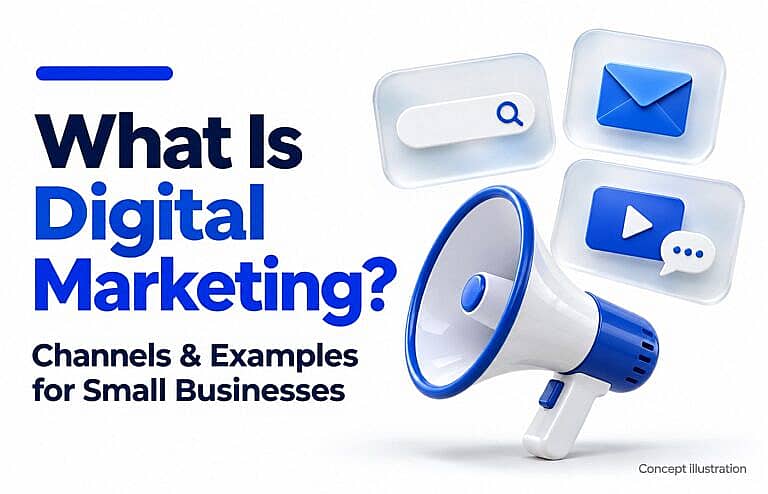
Digital marketing is the use of websites, search engines, social media, email and other digital channels to promote a business, attract customers and maintain customer relationships. It includes activities such as search engine optimisation, online advertising, educational content and email campaigns.
For a small business, digital marketing works best when those activities connect to a clear offer and a useful next step. That might be requesting a quote, booking an appointment, purchasing a product or subscribing to updates.
You do not need to use every channel. You need to reach the right people, explain your value and measure what happens next.
How Does Digital Marketing Work?
A practical digital marketing plan connects four jobs:
- Attract attention: Help relevant people discover your business.
- Build understanding: Explain what you offer, who it suits and why it matters.
- Make action easy: Provide a clear way to enquire, book or buy.
- Support the relationship: Help customers get value and return when they need you.
Customers may move between channels before deciding. Someone could discover you through a video, search your business name later and contact you through your website.
Our guide to marketing funnel stages and examples explains how to organise that journey without assuming everyone follows the same route.
Six Digital Marketing Channels and Approaches
These categories overlap. A useful video can appear on your website, support a social campaign and become part of an email.
1. Search Engine Optimisation
Search engine optimisation, or SEO, helps search engines understand your website and helps people discover relevant pages through unpaid results.
For a small business, this can involve improving service pages, answering customer questions, strengthening internal links and resolving technical problems that prevent indexing.
Google’s SEO Starter Guide explains these foundations and makes clear that following best practices does not guarantee first place.
Illustrative example: A bookkeeping business publishes a useful guide to preparing records for a bookkeeper, with a link to its service page.
Read our search engine positioning guide for a practical process for improving individual pages.
2. Paid Advertising
Paid advertising places your message in purchased advertising space, such as search results, social feeds or video platforms.
Google Search ads can reach people searching for relevant products or services. With cost-per-click bidding, you pay for clicks; other advertising formats and bidding arrangements work differently. Google’s online advertising guide explains the basic process.
Illustrative example: A plumber advertises a service it genuinely provides and sends visitors to a page showing coverage, availability and contact options.
Match the advertisement to the destination page. A relevant click is useful only if the visitor can understand the offer and take the next step.
Our Google Keyword Planner guide can help with researching search demand and campaign ideas.
3. Content Marketing
Content marketing uses helpful material to answer questions, demonstrate knowledge and support buying decisions.
Content can include:
- Articles and practical guides.
- Product demonstrations and tutorials.
- Comparison tables and checklists.
- Genuine customer stories and documented projects.
Illustrative example: A flooring retailer explains the differences between flooring materials, shows real samples and describes maintenance requirements.
Choose topics connected to actual customer questions. A useful explanation should help someone make a decision, even before they contact you.
Publishing more often is not a strategy by itself. Each piece should serve a purpose.
4. Social Media Marketing
Social media marketing involves publishing content, participating in conversations and promoting your business through social platforms. It can include both organic activity and paid advertising.
Choose platforms based on your audience and the content you can consistently produce. Treat this as a decision to test rather than assuming every business needs the same accounts.
Illustrative example: A bakery shares short decorating videos, answers product questions and directs interested customers to an ordering page.
Tools can help with scheduling and reporting once you have a clear plan. Our comparison of social media marketing tools explains different options and their practical limitations.
5. Email Marketing
Email marketing sends relevant updates, educational messages or offers to an appropriate subscriber audience.
Common uses include welcome messages, newsletters, product announcements and reminders that customers have agreed to receive.
Illustrative example: A gardening supplier offers seasonal planting tips to subscribers and links to relevant products.
For Canadian businesses, commercial electronic messages generally require valid consent, sender identification and a working unsubscribe mechanism. Review the CRTC’s guidance on Canada’s Anti-Spam Legislation, including applicable conditions and exceptions.
Keep marketing subscriptions clearly distinguishable from a customer’s request for a quote or support.
6. Local Search and Business Listings
Local search helps people find businesses serving a particular area. For eligible businesses, Google Business Profile is an important part of that presence.
Keep business details accurate, including services, hours and contact information. Google’s local ranking guidance explains the importance of complete information and factors such as relevance, distance and prominence.
Illustrative example: A repair shop maintains its profile, displays genuine photographs and makes its opening hours easy to confirm.
A business-directory listing is separate from a Google Business Profile. Assess directories for relevance and usefulness to customers; inclusion does not guarantee rankings or enquiries.
Which Channels Should a Small Business Start With?
Choose according to the customer’s situation, your offer and your capacity.
| Business situation | A sensible starting point |
|---|---|
| Customers actively search for your service | Useful service pages, SEO and local visibility; consider a measured search-ad test |
| Customers need to see the product in use | Demonstrations, social content and detailed product pages |
| Buyers need substantial explanation before deciding | Educational content, clear service information and appropriate email follow-up |
| Existing customers regularly need to reorder | Useful customer communications and permission-based email campaigns |
These are planning suggestions, not guaranteed formulas. Start with a manageable combination and improve it using real enquiries and sales.
Three Examples of Digital Marketing in Practice
The following scenarios are hypothetical, not HMDIA client results.
| Business | Connected marketing activities | Outcome to measure |
|---|---|---|
| Local electrician | Maintain accurate local information, explain each service on the website and test ads for relevant searches | Suitable enquiries and booked jobs |
| Online ceramics shop | Publish product videos, provide dimensions and delivery details, and invite newsletter subscriptions | Purchases, repeat orders and sales from campaigns |
| Small IT support company | Answer common business IT questions, explain support packages and offer a consultation | Qualified consultations and signed clients |
The connection between activities matters. Sending visitors to an unclear page or failing to respond to enquiries can undermine an otherwise useful campaign.
Build a Simple 30-Day Digital Marketing Plan
Use the first month to establish a working process rather than promising a fixed number of customers.
Week 1: Define the audience and offer. Choose one product or service, describe the customer it suits and decide what action you want them to take.
Week 2: Prepare the destination. Improve the relevant page, explain the offer and test the form, booking process or checkout on mobile.
Week 3: Launch a manageable campaign. Publish helpful content, distribute it through suitable channels and run a limited advertising test if it fits your plan.
Week 4: Review and refine. Check enquiries, sales and customer feedback. Identify whether the main problem is reaching people, explaining the offer or converting interest into business.
Use our 30-day content calendar guide to organise publishing and assign responsibilities.
How to Measure Digital Marketing Results
Choose measures that reflect your goal:
- Visibility: Relevant impressions and reach.
- Website activity: Visits to important pages and meaningful interactions.
- Lead generation: Valid enquiries, qualified consultations and bookings.
- Sales: Completed purchases, revenue and repeat customers.
- Efficiency: Campaign cost compared with useful outcomes.
Do not count every form submission as a suitable lead or every button click as a completed purchase.
Google Analytics supports campaign URL parameters, commonly called UTM parameters, to help identify traffic from links in campaigns. Use consistent naming and connect website reporting with your enquiry or sales records.
For a hypothetical campaign spending CAD $600 on ads and producing 12 valid enquiries, the advertising cost per enquiry is $50. That excludes other costs and does not establish profitability; you still need to know how many enquiries became customers.
Where Does AI Search Fit?
AI search is another way people may discover information about products, services and businesses.
For Google’s AI Overviews and AI Mode, existing SEO foundations remain relevant. Google says there are no additional technical requirements or special schema needed for these features. Eligible pages must be indexed and eligible to appear in Search with a snippet; inclusion is not guaranteed.
Follow Google’s AI search guidance, keep information accurate and make important explanations easy to find. Clear writing helps readers, but it cannot guarantee recommendations from an AI system.
Frequently Asked Questions
Is digital marketing the same as social media marketing?
No. Social media is one part of digital marketing. The broader activity also includes search, email, advertising, content and the website experience.
Can a small business start without paid advertising?
Yes. Start with useful website information, relevant organic content and customer relationships. These still require time and resources, even when you are not buying advertising space.
Does paying for Google Ads improve organic rankings?
No. Google states that advertising does not affect your website’s position in unpaid search results. Paid advertising and organic SEO serve different roles.
Turn Your Channels Into a Practical Marketing Plan
Start with one clear offer, choose channels your customers use and make the next step straightforward. Measure business outcomes, then improve the parts that need attention.
Explore HMDIA’s web design and digital marketing services for help connecting your website, SEO, content and advertising into a practical plan.