


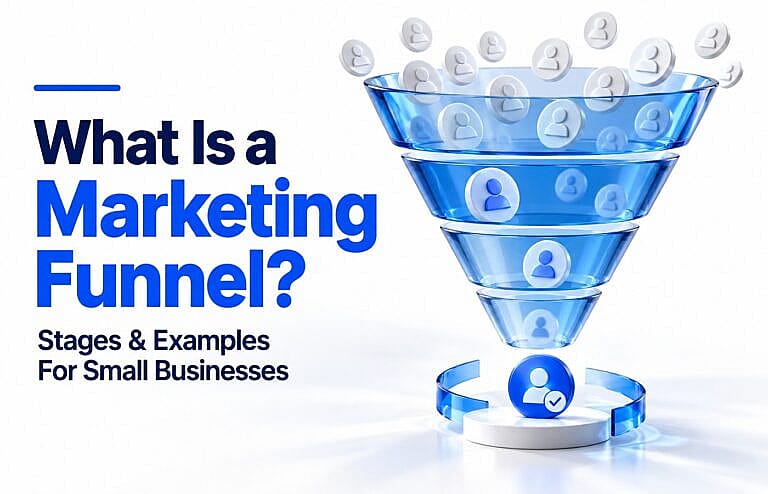
A marketing funnel is a model for planning how people discover your business, consider your offer, become customers, and continue their relationship with you. It helps you choose useful content, offer an appropriate next step, and measure where potential customers stop progressing.
For a small business, that might mean connecting a helpful Google search result to a service page, a quote request, a completed job, and a repeat booking.
You do not need a complicated automation system to start. You need a clear offer and a sensible path from interest to action.
How does a marketing funnel work?
The funnel represents a broad audience narrowing into a smaller group of buyers. Someone discovering a problem usually needs different information from someone choosing between two suppliers.
However, real customers do not always follow a straight line. They may compare options, leave, return through a different channel, or contact you after a referral. Google’s research on purchase decisions describes shoppers moving through exploration and evaluation before buying.
Use the funnel to organise your marketing, while making it easy for people to enter wherever they are ready.
Five practical marketing funnel stages
There is no single mandatory set of stages. Singapore Management University’s funnel guide describes awareness, consideration, conversion, and the relationship after purchase. For a small business, separating that last part into retention and advocacy creates this useful five-stage model.
1. Awareness: help the right people discover you
The customer’s question is: “Who can help with this problem?”
Publish information that connects a real customer need to your business. Useful starting points include educational articles, search listings, short demonstrations, community participation, and relevant advertising.
For example, a home-cleaning company could explain what is included in a move-out clean. The next step might be reading its service checklist, rather than immediately booking an unfamiliar company.
2. Consideration: help people evaluate your offer
The customer’s question becomes: “Is this the right option for me?”
Explain your process, service area, product specifications, pricing approach, and important limitations. Use genuine customer feedback and real project examples when available.
A visitor comparing cleaning companies may need to know whether appliances are included, what they must prepare, and how estimates work. Answering those questions is more useful than repeating that your service is “the best.”
3. Conversion: make the next meaningful action easy
The customer asks: “How do I get started?”
A conversion is a defined action, such as submitting a quote request, booking an appointment, or buying a product. A lead conversion and a completed sale are different outcomes; track them separately.
Use a clear call to action, a working mobile form, and an explanation of what happens next. HMDIA’s lead generation landing page examples show ways to connect an offer with a focused enquiry form.
4. Retention: make the customer relationship worth continuing
The customer’s question is: “Was this a good decision?”
Deliver what you promised, provide useful instructions, and make support easy to reach. Where relevant, offer a straightforward way to reorder or book again.
For a cleaning business, this could mean clear arrival details, a service follow-up, and an optional recurring booking. Retention begins with the experience you deliver, not just another promotional message.
5. Advocacy: make recommendations easy
The customer thinks: “Would I recommend this business?”
Invite honest feedback and make it easy to share your business with someone who needs it. Record referred enquiries so you can understand whether recommendations lead to suitable customers.
Advocacy also brings new people into the awareness stage, connecting your existing customer relationships with future business.
You may also see TOFU, MOFU, and BOFU: top, middle, and bottom of funnel. These broadly describe awareness, consideration, and conversion. Retention and advocacy extend the plan beyond the first purchase.
Three marketing funnel examples for small businesses
The following are hypothetical examples, not HMDIA client case studies or promised results.
Example 1: A local cleaning business
A homeowner finds a move-out cleaning guide through search. The guide links to a service page explaining coverage, exclusions, and how quotes are prepared.
The homeowner submits their property details. The business responds with a suitable quote and a clear booking process. After completing the job, it provides a simple way to arrange future cleaning and invites honest feedback.
What to measure: relevant service-page visits, valid quote requests, booked jobs, repeat bookings, and referred customers.
Potential improvement: if enquiries arrive but few become bookings, investigate quote clarity, availability, and response time before buying more traffic.
Example 2: A small online homeware shop
A shopper discovers a short video showing how to style a compact dining table. They visit the featured products and compare dimensions, materials, delivery information, and returns.
Clear product details help them choose. A straightforward checkout completes the purchase. Afterwards, care instructions support their experience, while optional updates introduce relevant new collections.
What to measure: product views, add-to-cart actions, checkout starts, purchases, and repeat customers.
Potential improvement: if shoppers add products but abandon checkout, check unexpected charges, delivery restrictions, payment errors, and usability.
Example 3: A business-to-business bookkeeping service
A business owner reads a guide about preparing records for a bookkeeper. They then review the firm’s service scope, supported software, and onboarding process.
The owner requests a consultation. The firm checks whether the business is a suitable fit, prepares a proposal, and explains the next steps. After signup, clear onboarding and regular communication support an ongoing relationship.
What to measure: qualified consultations, proposals, signed clients, renewals, and referrals.
Potential improvement: if many consultations are unsuitable, make eligibility and service scope clearer before the booking step.
How to build your first marketing funnel
Start with one audience and one offer
Choose a specific service or product category. “Homeowners arranging move-out cleaning” gives you a clearer starting point than “everyone who needs cleaning.”
Define what makes someone a suitable customer, including location, requirements, and the problem you can solve.
Work backwards from the business outcome
Decide whether success means a paid order, a booked job, or a signed agreement. Then identify the actions that normally lead there.
A consultation request may be an important milestone, but it should not be reported as a new paying customer.
Build the essential content and next steps
Start with one discovery channel, a useful explanation of your offer, relevant proof, and a clear action.
Give each piece of content a job. An educational article can answer an early question; a comparison or service page can resolve uncertainty; a booking page can explain how to proceed.
Use HMDIA’s 30-day content calendar guide to schedule those pieces and assign responsibility.
Assign follow-up and test the full path
Decide who responds to enquiries and how they record the outcome. Separate requested replies from optional ongoing marketing, and obtain permission for the latter.
Test the journey on mobile: open the page, use the form, confirm delivery, and check the confirmation message. A working submission should tell the customer what happens next.
How to measure your marketing funnel
Choose measures that reflect each stage’s purpose.
| Stage | Useful measures |
|---|---|
| Awareness | Relevant search impressions, reach, and new visitors |
| Consideration | Visits to service or pricing pages, resource requests, and qualified enquiries |
| Conversion | Completed bookings, purchases, signed agreements, and lead-to-customer rate |
| Retention | Repeat purchases, repeat bookings, and renewals |
| Advocacy | Referred enquiries and customers acquired through referrals |
In Google Analytics 4, you can mark an important recorded action as a key event. Its funnel exploration can show progression through configured steps.
Check that tracking records successful actions, not only button clicks. Connect website reports with your enquiry and sales records; analytics alone will not capture every conversation or offline sale.
A simple calculation example
Suppose a hypothetical group of 500 distinct landing-page visitors produces 25 valid quote requests and five paying customers within a defined 30-day follow-up window.
- Visitor-to-enquiry rate: 25 ÷ 500 × 100 = 5%.
- Enquiry-to-customer rate: 5 ÷ 25 × 100 = 20%.
- Visitor-to-customer rate: 5 ÷ 500 × 100 = 1%.
These figures illustrate the calculation; they are not industry benchmarks. Use consistent definitions, the same customer group, and enough time for people to make a decision.
If visits are healthy but enquiries are scarce, review the offer and page experience. If enquiries are plentiful but sales are weak, investigate lead quality and follow-up. HMDIA’s guide to website traffic without leads explores the first problem in more detail.
Frequently asked questions
What is the difference between a marketing funnel and a sales funnel?
A marketing funnel usually covers discovery, interest, and the wider customer relationship. A sales funnel focuses more closely on progressing prospects towards a purchase, such as qualification, proposals, and closing. They overlap, especially in small businesses where one person handles both.
Is a marketing funnel outdated?
It remains useful as a planning and measurement model. Its limitation is assuming that everyone follows an identical sequence. Allow for referrals, repeat visits, comparison shopping, and customers who arrive ready to buy.
Do I need paid ads or funnel software?
No. You can begin with your website, an organic discovery channel, a contact or checkout process, and a simple way to record outcomes. Add tools when they solve a specific problem you can identify.
Turn your funnel into a practical plan
Choose one audience, clarify one offer, and connect useful information to a measurable next step. Review where people hesitate and improve that part of the experience.
For help connecting your website with that plan, explore HMDIA’s web design and digital marketing services or contact HMDIA.